Victoria Bazir

The payment moved from Singapore to the U.S. and settled within minutes, compared with up to two business days through conventional cross-border banking infrastructure.
| Parameter | Details |
| Banks | DBS and Citi |
| Currency | USD |
| Route | Singapore → U.S. |
| Timing | Weekend |
| Settlement time | Minutes |
| Traditional processing | Up to 2 business days |
| Asset | Tokenized bank deposits |
| Network | Swift Digital Ledger |
| Architecture | Permissioned blockchain |
| EVM compatibility | Yes |
| Technology | Hyperledger Besu |
| Public blockchain | No |
| Stablecoin rail | No |
What Swift Digital Ledger actually does
Swift’s Digital Ledger should not be confused with a public blockchain such as Ethereum or a stablecoin settlement network.
It is a permissioned orchestration layer connecting participating financial institutions and their tokenized deposit infrastructure.
The ledger is built on an EVM-compatible architecture using Hyperledger Besu, an enterprise Ethereum client designed to support both public and permissioned networks.
In practical terms, the ledger provides banks with a shared environment for coordinating transactions while the underlying money remains commercial bank deposits represented as digital tokens.
This distinction matters:
- Stablecoin: token issued by a separate issuer and backed by reserves.
- Tokenized deposit: digital representation of money deposited directly with a regulated commercial bank.
DBS and Citi therefore did not need to convert USD deposits into a third-party stablecoin to execute the transaction.

Why the weekend payment matters
Cross-border USD payments can be delayed by bank operating hours, settlement windows, time-zone differences and weekends. The Singapore → U.S. route makes this particularly visible: Singapore is roughly 12–13 hours ahead of New York, depending on U.S. daylight saving time.
Using tokenized deposits and Swift’s ledger allowed the banks to process the payment during the weekend rather than waiting for the next conventional banking window.
The result:
up to 2 business days → minutes
The test demonstrates a concrete use case for tokenized commercial bank money: 24/7 cross-border payments without moving settlement onto a public blockchain or introducing a stablecoin as the payment asset.
Technical stack
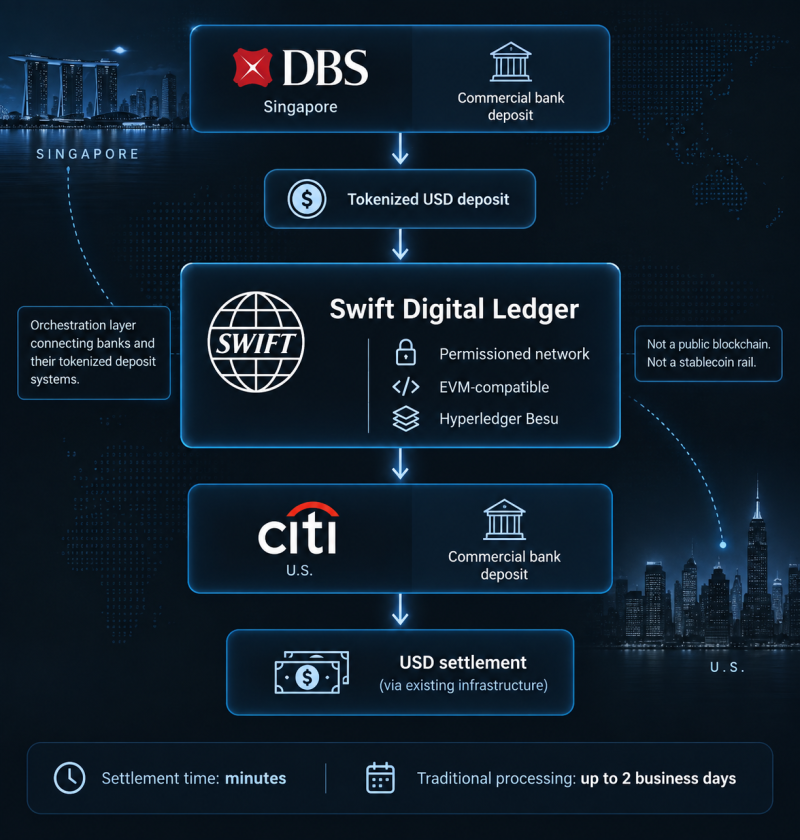
The important part is the EVM-compatible architecture. It gives Swift access to Ethereum-compatible execution and tooling while maintaining a permissioned environment where participation can be restricted to approved financial institutions.
The DBS-Citi transaction is therefore less a “crypto payment” than an infrastructure upgrade: bank deposits remain bank money, while blockchain technology provides the coordination layer needed to move them across borders outside conventional settlement hours.
 Victoria Bazir