Victoria Bazir

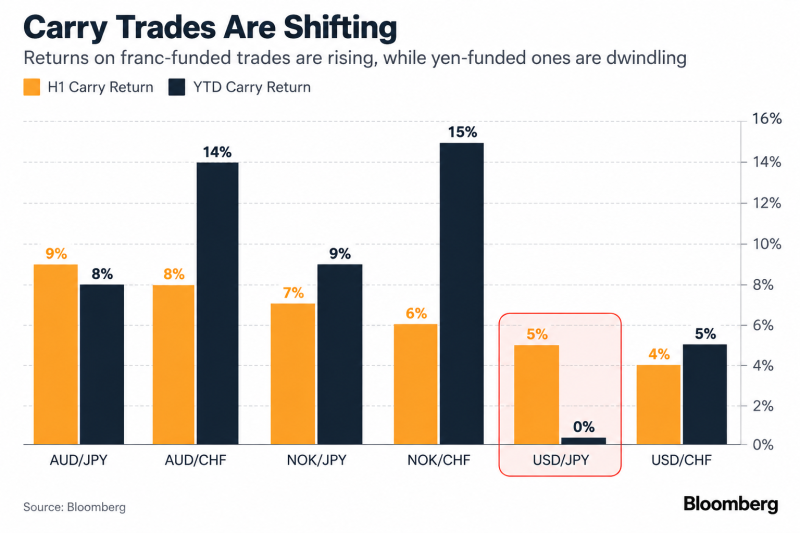
Bloomberg data shows AUD/CHF returning about 14% YTD versus 8% for AUD/JPY, while NOK/CHF has gained roughly 15% versus 9% for NOK/JPY. USD/CHF is up about 5%, compared with a near-zero return for USD/JPY.
| Trade | H1YTD | |
| AUD/JPY | ~9% | ~8% |
| AUD/CHF | ~8% | ~14% |
| NOK/JPY | ~7% | ~9% |
| NOK/CHF | ~6% | ~15% |
| USD/JPY | ~5% | ~0% |
| USD/CHF | ~4% | ~5% |
The largest H1-to-YTD improvement is NOK/CHF, up 9 percentage points. USD/JPY moved in the opposite direction, falling from roughly 5% in H1 to near zero YTD.
The Gap Widened After July
The trend changes direction with greater clarity when you examine the profits from the final six months of the year. The Australian Dollar compared to the Japanese Yen produced a gain of 9 % during the first six months - but this currency pair decreased in value by 1.3% since the month of July began. During this same period in the latter half of the year, the Australian Dollar compared to the Swiss Franc resulted in a profit of 14 %.
That puts the H2 performance gap between the two funding currencies at more than 15 percentage points.
- AUD funded with yen: -1.3% since July.
- AUD funded with Swiss francs: +14%.
Franc-funded trades have also extended their gains since H1. AUD/CHF increased from roughly 8% to 14% YTD, while NOK/CHF climbed from around 6% to 15%.
Policy Is Changing the Trade
The shift coincides with diverging policy signals from Japan and Switzerland. Two joint US-Japan interventions this year signaled support for a stronger yen. Yen appreciation raises the cost of closing yen-funded positions, reducing the currency's appeal as a funding source.
Switzerland presents a different setup. Interest rates are expected to remain near zero through 2027, while policymakers appear more tolerant of franc weakness.
Across the three comparable trades, the YTD advantage of CHF funding is clear:
AUD: +6 pp | NOK: +6 pp | USD: +5 pp
The Swedish krona is also gaining traction as an alternative funding currency.
The traders who borrow in one currency to invest in another find that the value of the currency they borrow is equal in importance to the difference between interest rates. There are current data on profits which show that investors who borrow Swiss francs have more money than the investors who use Japanese yen for the same purpose.
 Victoria Bazir