Marina Lyubimova

- Inside the 30-Year Treasury
- Back to a Rate Regime Last Seen in 2004
- Four Forces Behind Higher Long-Term Rates
- The Extra Risk in Going From 10 to 30 Years
- A 100-Basis-Point Move Can Be Brutal
- The Mortgage Market Feels the Repricing
- Higher Discount Rates Challenge Equity Valuations
- Corporate Refinancing Gets More Expensive
- Washington Doesn't Feel the Full Cost Immediately
- The Bigger Question Is How Long 5%+ Rates Last
The move matters beyond the bond market because long-term Treasury yields influence borrowing costs, mortgage rates, corporate debt and asset valuations.
Inside the 30-Year Treasury
| Parameter | Specification |
| Issuer | U.S. Treasury |
| Maturity | 30 years |
| Interest | Fixed coupon |
| Coupon payments | Semiannual |
| Principal | Repaid at maturity |
| Yield | Market-determined |
| Main risks | Interest rates, inflation, duration |
| Price/yield relationship | Prices fall when yields rise |
The coupon rate determines scheduled interest payments, while the yield reflects the return implied by the bond's current market price. Bond prices and yields move in opposite directions.
Back to a Rate Regime Last Seen in 2004
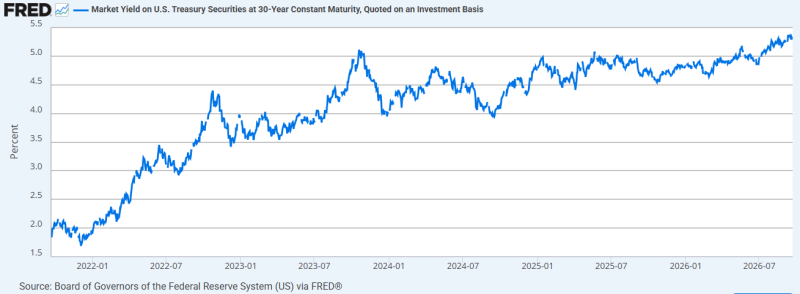
A yield above 5.37% puts the 30-year Treasury around levels last seen in 2004 and far above those that dominated the post-2008 period.
| Period | 30-Year Yield Environment |
| Early 2000s | Around 5% was common |
| Post-2008 | Mostly lower yields |
| 2020–2021 | Historically low rates |
| 2022 onward | Sharp normalization |
| 2026 | Above 5.37% |
The key change is the cost of long-term capital. Investors now require substantially higher returns to hold U.S. government debt for three decades than during the low-rate era.
Four Forces Behind Higher Long-Term Rates
Four factors are especially important:
- Inflation: Higher expected inflation reduces the real value of future fixed payments, pushing investors to demand higher nominal yields.
- Fed expectations: The Federal Reserve controls short-term rates, but expectations for its future policy path affect longer maturities.
- Treasury supply: Heavy government borrowing increases the amount of debt investors must absorb.
- Term premium: Investors may demand additional compensation for taking 30 years of inflation and interest-rate risk.
A simplified representation is:
Long-term Treasury yield ≈ expected short-term rates + inflation compensation + term premium
The Extra Risk in Going From 10 to 30 Years
The 30-year bond carries considerably more duration risk than the benchmark 10-year Treasury.
| Feature | 10-Year | 30-Year |
| Maturity | 10 years | 30 years |
| Duration risk | High | Very high |
| Inflation exposure | High | Higher |
| Price sensitivity | High | Higher |
| Primary role | Market benchmark | Long-duration benchmark |
This makes the 30-year Treasury particularly sensitive to changes in long-term inflation, fiscal and interest-rate expectations.
A 100-Basis-Point Move Can Be Brutal
When newly issued Treasuries offer higher yields, older bonds with lower coupons become less attractive. Their prices decline until their effective yields become competitive.
If a bond has a modified duration of 14, a 100-basis-point increase in yield implies approximately:
14 × 1% = 14% price decline
before accounting for convexity.
That sensitivity explains why long-duration bonds can experience large losses even when yields move by only one percentage point.
The Mortgage Market Feels the Repricing
The 30-year Treasury does not directly set the U.S. 30-year mortgage rate. Mortgage pricing depends heavily on mortgage-backed securities, Treasury benchmarks and credit/prepayment spreads. Still, sustained increases in long-term Treasury yields generally translate into higher financing costs.
That means higher monthly payments, lower affordability and weaker incentives to refinance existing mortgages.
Higher Discount Rates Challenge Equity Valuations
Treasury yields affect equity valuations because the risk-free rate is part of the discount rate used to value future cash flows.
Present Value = Future Cash Flow / (1 + discount rate)^n
Higher discount rates reduce the present value of future earnings. Companies whose valuations depend heavily on profits expected many years ahead are particularly sensitive.
Higher Treasury yields also increase the return available from government bonds, making fixed income more competitive with equities.
Corporate Refinancing Gets More Expensive
Corporate borrowing costs are generally built on top of Treasury benchmarks:
Corporate yield ≈ Treasury yield + credit spread
For example:
| Treasury Yield | Credit Spread | Corporate Yield |
| 4.0% | 1.5% | 5.5% |
| 5.0% | 1.5% | 6.5% |
A one-percentage-point increase in the underlying Treasury rate therefore raises borrowing costs by roughly the same amount if the credit spread is unchanged.
Washington Doesn't Feel the Full Cost Immediately
Higher market yields do not immediately increase the cost of existing fixed-rate federal debt.
The effect appears as debt matures and the Treasury refinances it at current rates. If yields remain elevated, a growing portion of federal debt is gradually replaced with more expensive borrowing.
The Bigger Question Is How Long 5%+ Rates Last
The 5.37% level is historically significant, but the larger issue is whether long-term Treasury yields remain structurally higher than during the post-2008 period.
Inflation, Federal Reserve expectations, Treasury issuance, economic growth and the term premium will determine whether the current move proves temporary or establishes a higher long-term range.
If yields remain elevated, the consequences spread across the economy: higher mortgage and corporate financing costs, greater federal interest expense, lower prices for existing long-duration bonds and higher discount rates for equities.
 Marina Lyubimova