Peter Smith

The revision adds about 0.4 percentage points to the government's previous estimate.
Italy's 2026 outlook
| Indicator | April 2026 | Latest outlook |
| Real GDP growth | 0.6% | Nearly 1.0% |
| Budget deficit | 2.9% of GDP | Around 2.9% or lower |
| Public debt | 138%+ of GDP | Nearly 139% |
| 2027 GDP growth | 0.6% | Around 0.6% |
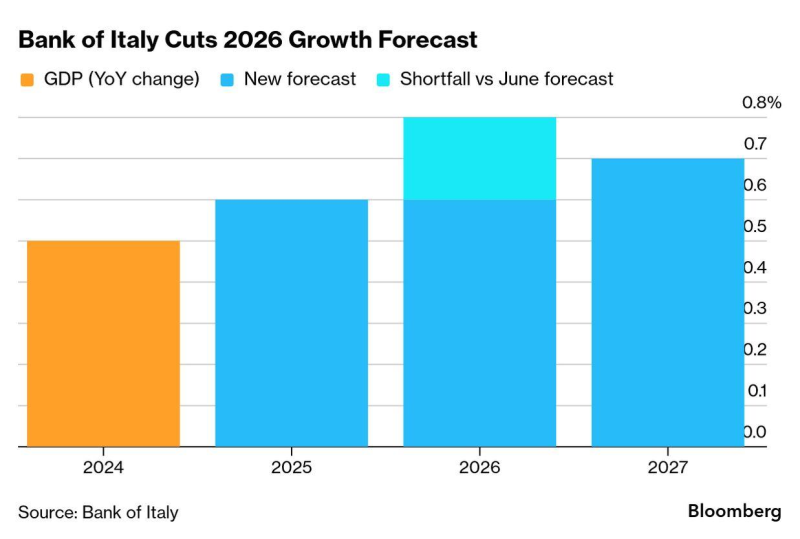
Chart: Italy 2026 GDP Growth Forecasts
- Government, April 2026 — 0.6%
- European Commission, May 2026 — 0.5%
- Bank of Italy — 0.6%
- Government, October 2026 — nearly 1.0%
Why the forecast was raised
The April forecast was lowered to 0.6% amid higher energy prices and geopolitical uncertainty. Economic activity later proved stronger than expected, leading the government to revise the full-year estimate upward.
The picture is still mixed. Industrial production fell 1.0% month on month in June and 0.6% year on year, showing continued weakness in manufacturing.
Deficit and debt
Italy expects its 2026 budget deficit to remain around 2.9% of GDP, down from 3.1% in 2025. That would put the deficit below the EU's 3% threshold. Public debt remains the main fiscal risk. It is expected to reach almost 139% of GDP in 2026. Faster GDP growth improves the near-term outlook, but Italy's debt burden still limits fiscal room.
Defence spending
Italy has also reduced its planned increase in defence expenditure. Additional defence spending is now expected at around 0.6% of GDP, compared with an earlier plan of 0.9%. Extra expenditure is expected to total about €14 billion per year in 2027 and 2028.
Inflation risk
Italy's EU-harmonised inflation rate reached 4.1% in September. Higher inflation can weaken household consumption and keep borrowing costs elevated, which is especially important for a country with debt close to 139% of GDP.
Bottom line
Italy now expects nearly 1% GDP growth in 2026, versus 0.6% in April. The upgrade improves the short-term outlook, but the key constraints remain unchanged: high public debt, inflation and limited fiscal space.
 Peter Smith