Marina Lyubimova
- What is available on Bloomberg
- Commodity perpetuals
- Index perpetuals
- Semiconductor stocks dominate the equity list
- FX perpetuals are also included
- Crypto remains part of the package
- HIP-3 volumes show why traditional assets matter
- Technical structure
- How this compares with the previous setup
- Why 24/7 stock and commodity markets matter
- Bloomberg makes the basis visible
- From crypto perpetuals to global markets
The Bloomberg screen includes Hyperliquid-linked contracts across commodities, stock indexes, equities, currencies and crypto, including Brent, WTI, gold, the S&P 500, Nvidia, Intel, EUR/USD, BTC and ETH.
The development follows President Donald Trump’s statement that the CFTC was working on a compliant path for Hyperliquid in the U.S.
What is available on Bloomberg
The Bloomberg Terminal screen lists 23 Hyperliquid perpetual markets, plus the HYPE spot rate.
| Asset class | Number of perpetuals | Examples |
| Commodities | 5 | Brent, WTI, natural gas, gold, silver |
| Indexes | 3 | S&P 500, XYZ 100, Japan 225 |
| Equities | 8 | Nvidia, Intel, Micron, Sandisk, Circle |
| Currencies | 3 | EUR/USD, GBP/USD, USD/JPY |
| Crypto | 3 | BTC, ETH, HYPE |
Bloomberg labels the section “Hyperliquid Perpetuals & Token (24x7)”, reflecting continuous trading outside conventional market hours.
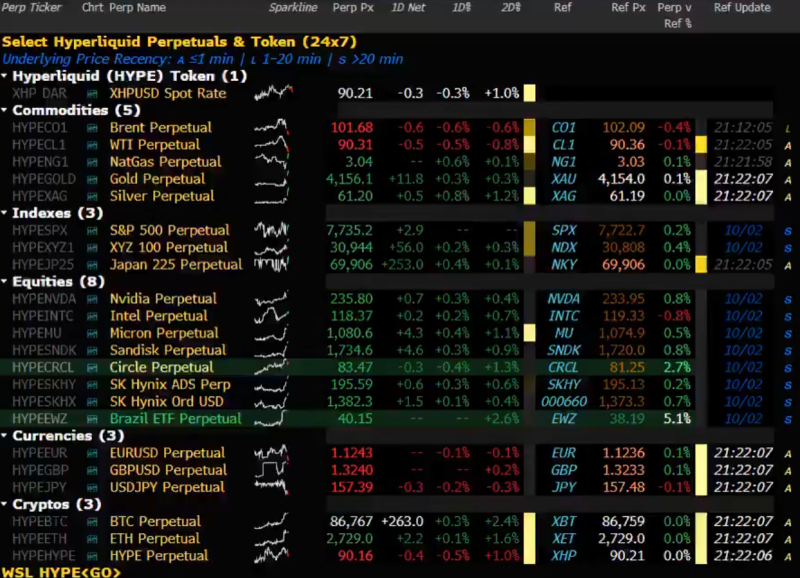
Hyperliquid perpetual markets on Bloomberg Terminal across commodities, indexes, equities, currencies and crypto.
Commodity perpetuals
Five commodity contracts appear on the screen: Brent, WTI, natural gas, gold and silver.
The Bloomberg display puts the Hyperliquid perpetual price directly beside its conventional reference price. WTI, for example, trades at 90.31 versus 90.36 for the CL1 reference, a difference of about -0.06%.
Gold is at 4,156.1 versus 4,154.0 for XAU, a gap of roughly +0.05%. Brent trades at 101.68 versus 102.09, while silver is at 61.20 versus 61.19.
This makes the premium or discount to the reference market visible without leaving Bloomberg.
Index perpetuals
The terminal includes S&P 500, XYZ 100 and Japan 225 perpetuals. The Hyperliquid S&P 500 perpetual trades at 7,735.2, compared with an SPX reference of 7,722.7, a difference of about 0.16%. XYZ 100 is quoted at 30,944 against an NDX reference of 30,808, while Japan 225 is at 69,906, matching its NKY reference on the captured screen.
Semiconductor stocks dominate the equity list
Eight equity-linked contracts appear on Bloomberg, with semiconductor companies accounting for most of them.
The screen includes:
- Nvidia: 235.80 vs. NVDA reference 233.95
- Intel: 118.37 vs. 119.33
- Micron: 1,080.6 vs. 1,074.9
- Sandisk: 1,734.6 vs. 1,720.0
- Circle: 83.47 vs. 81.25
- SK Hynix ADS: 195.59 vs. 195.13
- SK Hynix ordinary shares: 1,382.3 vs. 1,373.3
- Brazil ETF perpetual: 40.15 vs. 38.19
Nvidia, Intel, Micron, Sandisk and SK Hynix give the equity section a clear semiconductor focus.
FX perpetuals are also included
Three major currency pairs are available:
- EUR/USD trades at 1.1243 versus a reference of 1.1236
- GBP/USD at 1.3240 versus 1.3233
- USD/JPY at 157.39 versus 157.48.
These are perpetual derivatives rather than conventional spot-FX positions.
Crypto remains part of the package
Bloomberg also displays Hyperliquid’s main crypto perpetuals. BTC is quoted at 86,767, compared with a reference price of 86,759. ETH is at 2,729.0 on both the perpetual and reference market, while HYPE trades at 90.16 versus a reference of 90.21. A separate HYPE/USD spot rate of 90.21 is also displayed.
The main Bloomberg prices can therefore be summarized as follows:
| Market | Hyperliquid perp | Reference | Approx. difference |
| Brent | 101.68 | 102.09 | -0.40% |
| WTI | 90.31 | 90.36 | -0.06% |
| Gold | 4,156.1 | 4,154.0 | +0.05% |
| S&P 500 | 7,735.2 | 7,722.7 | +0.16% |
| Nvidia | 235.80 | 233.95 | +0.79% |
| EUR/USD | 1.1243 | 1.1236 | +0.06% |
| BTC | 86,767 | 86,759 | +0.01% |
HIP-3 volumes show why traditional assets matter
HIP-3 trading volume increased sharply from January through mid-June.
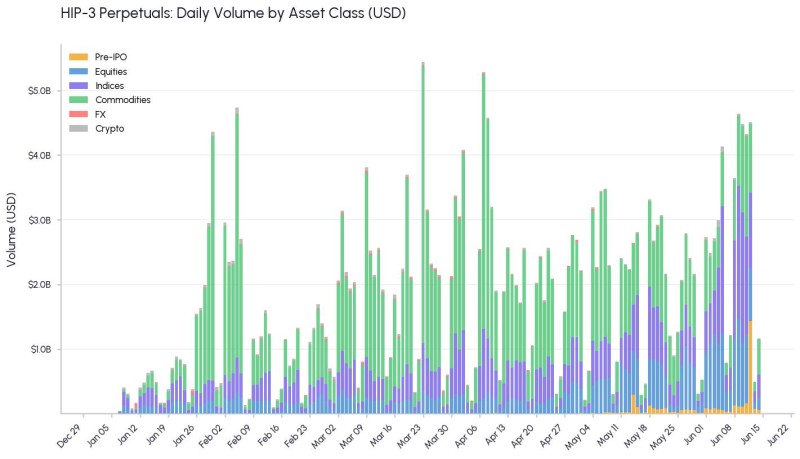
HIP-3 daily trading volume by asset class. Commodities generated the largest spikes, while equities and indices gained share toward May and June.
Daily volume was generally below $1 billion in early January. By late January, individual sessions were approaching $4.3 billion, followed by a roughly $4.7 billion spike in early February.
Activity reached its highest visible level in late March at approximately $5.4 billion, with another peak of about $5.3 billion in early April.
By early-to-mid June, several sessions were again in the $4.3–$4.6 billion range. Commodities generated most of the largest spikes. This corresponds with the Brent, WTI, natural gas, gold and silver perpetuals now displayed on Bloomberg.
Volume mix is becoming more diversified
The composition of HIP-3 activity also changed during the period.
Commodities dominated the largest early spikes, but equity and index volumes became more significant during May and June. On some June sessions, equities contributed roughly $1 billion or more, while index perpetuals added more than $1 billion.
Pre-IPO products remained a smaller component, while FX and crypto represented relatively limited shares on most days shown.
HIP-3 moved from sub-$1 billion daily volumes in January to repeated $3–5 billion sessions, with commodities producing the largest spikes.
Technical structure
The Bloomberg integration is a market-data integration rather than a new type of contract.
Key specifications are:
- Instrument: perpetual derivative
- Expiration: none
- Trading: 24/7
- Price: live Hyperliquid perpetual market
- Reference: conventional market benchmark
- Asset classes: commodities, indexes, equities, FX and crypto
- Bloomberg tickers: dedicated HYPE-prefixed identifiers
Bloomberg also displays a “Ref Update” field showing how recently the reference market price was updated.
Its Underlying Price Recency indicators are:
- A — less than 1 minute
- L — 1–20 minutes
- S — more than 20 minutes
This matters when a Hyperliquid market is trading while its conventional reference market is closed.

How this compares with the previous setup
The main change is distribution rather than contract design.
| Previous setup | Bloomberg Terminal integration |
| Prices mainly accessed through Hyperliquid and crypto interfaces | Prices visible directly in Bloomberg |
| Audience primarily crypto-native | Available in institutional market workflows |
| Perp and reference prices compared separately | Both displayed side by side |
| Crypto products had the highest visibility | Commodities, equities, indexes and FX are prominent |
| 24/7 prices sat outside mainstream financial terminals | 24/7 prices appear inside Bloomberg |
The underlying Hyperliquid perpetual model remains the same. Bloomberg adds an institutional data layer around it.
Why 24/7 stock and commodity markets matter
Traditional stocks and many commodity markets operate on fixed trading schedules. Hyperliquid perpetuals continue trading around the clock.
For example, Bloomberg shows:
- Nvidia Perpetual: 235.80
- NVDA reference: 233.95
If material Nvidia news appears while Nasdaq is closed, the perpetual can continue repricing. The same applies to oil during a geopolitical event or gold during a major macro development.
This can provide an additional source of out-of-hours price discovery. However, a perpetual price does not necessarily predict where the underlying market will reopen. Differences can reflect liquidity, funding, leverage, positioning and the age of the reference price.
That is why Bloomberg’s reference-price recency indicator is particularly relevant for these markets.
Bloomberg makes the basis visible
One of the most useful features of the screen is the direct comparison between the Hyperliquid price and its reference. Most of the captured markets show relatively small gaps: around 0.01% for BTC, 0.05% for gold, 0.06% for WTI and 0.16% for the S&P 500.
Nvidia shows a wider gap of approximately 0.79%, while Brent is about 0.40% below its reference.
These differences should not automatically be treated as arbitrage opportunities. If the conventional market is closed or its reference price is stale, the Hyperliquid perpetual may already be incorporating newer information.
From crypto perpetuals to global markets
Bloomberg now displays Hyperliquid perpetuals across energy, metals, stock indexes, semiconductor equities, FX and crypto.
HIP-3 volume shows that this expansion is already generating meaningful trading activity. Daily turnover moved from below $1 billion in early January to repeated multi-billion-dollar sessions, with visible peaks around $5.4 billion.
Commodities generated the largest volume spikes, while equities and indices became increasingly important toward June.
The Bloomberg integration therefore does not introduce a new Hyperliquid contract model. It brings existing 24/7 markets, already handling billions of dollars in daily HIP-3 volume on peak sessions — into an institutional market-data environment.
 Marina Lyubimova